


Words by Wayne Scott
There are some in motorsport who become legendary for their driving talent, and then there are those who changed the way racing does business. Bob Tullius was both.
Robert Charles “Bob” Tullius, co-founder of the legendary Group 44 and one of the most influential figures in modern sports-car racing, has died at the age of 95. He passed away at home in Port Orange, Florida, only a few miles from Daytona International Speedway – a fittingly close connection to the circuit that featured in so many of his greatest racing memories.
I had the immense privilege of interviewing Bob during what proved to be his final visit to the UK in 2018. The setting was Lincoln Showground and, true to reputation, he arrived with the air of a man not especially fond of interviews and certainly not inclined to suffer fools.
Yet after only a few minutes, we hit it off and got along really well, and he showed his warm wit and appreciation for genuine fans.
What followed was a completely spellbinding hour in the sunshine with a captivated audience listening to stories from one of the great eras of sports-car racing. It remains one of the highlights of my life. Afterwards, he thanked me for keeping him ‘interesting’ and ‘interested’ during our interview.
At one point, he even told me that of all the cars he raced, his favourite was the TR8 – perhaps the perfect choice for a driver whose career began with Triumph and who built his reputation on the success of British sports cars in America. He had a fondness for the E-type but felt slightly ‘robbed’ by TWR taking in the Group C challenge for Jaguar when Group 44 had worked so hard on the IMSA XJR5.
Over more than 25 years at the heart of American road racing, Tullius built Group 44 into one of the most successful and recognisable teams of its era. The distinctive green-and-white cars became synonymous with immaculate preparation, professional presentation and formidable pace, collecting more than 300 race wins, 14 national titles and three Trans-Am championships across SCCA, Trans-Am and IMSA competition.
TRIUMPH BEGINNINGS
Born in Rochester, New York, in 1930, Tullius developed a fascination with motorsport at a young age. After service in the U.S. Air Force and a spell working for Kodak, his route into racing came almost by accident. In 1960 he took his wife’s Triumph TR3 to a driving school and promptly won the race held at the end of the course.
That success set him on a path that would soon see him become one of the leading drivers in American club racing. With support from Triumph’s U.S. operation, he campaigned a Triumph TR4 to the 1962 SCCA E-Production national championship before securing back-to-back D-Production titles in 1963 and 1964.
In 1965 he joined forces with mechanic Brian Fuerstenau and advertising executive Dick Gilmartin to establish Group 44, named after the race number that had become his trademark.
CHANGING RACING FOREVER
Group 44 quickly became much more than a club racing outfit. With manufacturer support from British Leyland and sponsorship from Quaker State, the team pioneered a level of professionalism rarely seen in the sport at the time. The cars, transporters, uniforms and branding were all presented with a cohesive brand identity, and Tullius placed great emphasis on marketing, promotion and public relations long before such practices became standard in motorsport. As a result, everyone knew about Group 44, its green stripes, and incredible 18-year-long sponsorship from oil company Quaker State.
But behind the polished image wa genuine talent. Tullius himself was a formidable driver, and in 1966, he wrote his name into the history books by winning the very first race of the SCCA Trans-Am series at Sebring in a Dodge Dart. Over the following years, he added 21 Trans-Am victories and countless successes in Triumph machinery, including Spitfires, GT6s and the TR series.
One highlight came in 1980 when he shared a class-winning Triumph TR8 at the Sebring 12 Hours with Bill Adam – a result that reflected his long association with British sports cars.
JAGUAR LEGACY
For Jaguar enthusiasts, however, the most memorable chapter came when Group 44 began campaigning Jaguars in the mid-1970s. Tullius first raced a V12 E-type to the 1975 SCCA B-Production national championship before turning his attention to the Jaguar XJS in Trans-Am competition.
The big V12 coupe proved remarkably effective. In 1977, Tullius won the Trans-Am Category 1 title with five victories from eleven races. A year later, he repeated the feat in even more emphatic fashion, winning seven consecutive races to secure the drivers’ championship and deliver Jaguar its first manufacturers’ title in the series.
Group 44’s ambitions then expanded into the prototype ranks. Working with designer Lee Dykstra and stylist Randy Wittine, the team developed the Jaguar XJR-5 for IMSA’s GTP category. Debuting in 1982, the car went on to score nine race victories and played a key role in returning Jaguar to the 24 Hours of Le Mans. In 1985, the programme achieved a memorable class win at the French endurance classic.
Tullius himself claimed 10 IMSA GTP class victories during this period, and his final race win as a driver came in the 1986 three-hour race at Daytona aboard the successor Jaguar XJR-7.
THE LATER YEARS
After the Jaguar programme ended, Group 44 continued to influence top-level racing, running Audi’s Trans-Am campaign and helping Hurley Haywood secure the 1988 championship.
Though widely associated with British cars, Tullius’s career encompassed an extraordinary variety of machinery. He drove everything from the turbine-powered Howmet sports car at Le Mans and Watkins Glen to a NART Ferrari 512 BB at Daytona, along with NASCAR machinery and the legendary “Gray Ghost” Pontiac Tempest in Trans-Am competition.
Away from the track he nurtured another passion: aviation. For his 60th birthday he acquired a P-51D Mustang fighter aircraft, which he flew for many years before donating it to the RAF Museum in London in memory of wartime pilot Captain Donald Emerson.
Bob Tullius leaves behind a legacy as a racer, innovator and team owner who helped shape the professional era of sports-car racing. He is survived by his daughter, daughter-in-law, eight grandchildren and three great-grandchildren
The May edition of Jaguar Enthusiast Magazine will be dedicated to the memory of Bob Tullius, where we will celebrate his life, revisit some of his famous cars and tell the story of this great man who championed the British brands, and Jaguar in particular, across America.
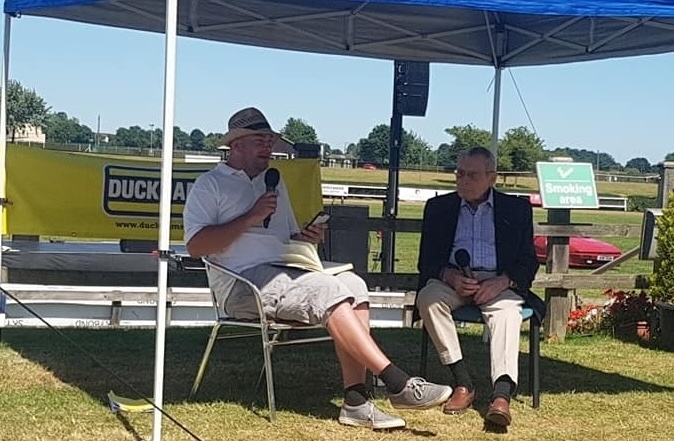
Wayne Scott interviewing Bob Tullius in 2008 at Lincoln Showground for the Piston in the Park and TR International event.