

Photos by Matthew Pitts
The Great British Jaguar Day at Bicester Motion felt like one of those events that will be talked about for years to come, not simply because of the cars gathered there, but because of what it revealed about Jaguar’s enduring appeal.


Hosted by Chris Harris on Cars, Bicester Motion and Car & Classic, the event brought together Jaguar people from across the spectrum: owners, collectors, designers, engineers, historians, influencers and the simply curious. It was a celebration of the marque in its broadest sense, from early XK models to the controversial Type 00 concept and Jaguar’s future direction.

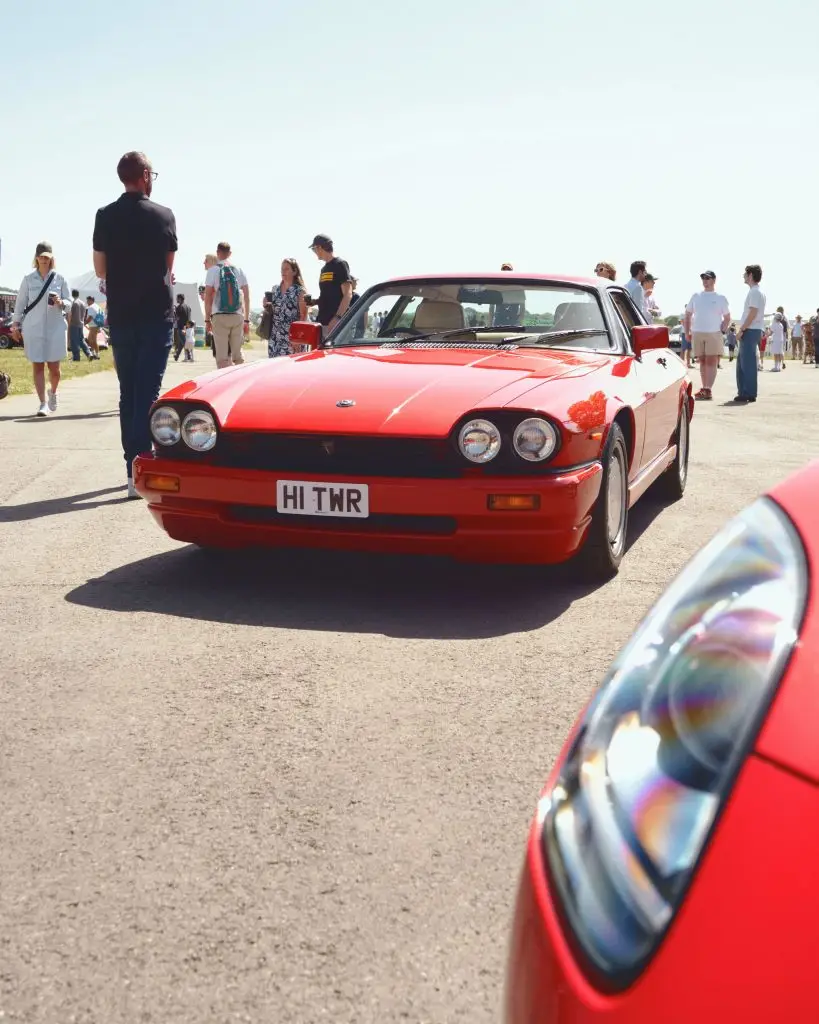
Helped enormously by glorious weather, Bicester’s avenues, hangars and display areas were bathed in sunshine throughout the day, and the atmosphere felt more like a summer garden party than a traditional car show. For a one-off event looking to make an impression, it could hardly have hoped for better conditions.

At the heart of the event was Hangar 113, which may well have contained the most historically significant collection of Jaguars ever assembled in one place. Goodwood Revival heroes sat alongside cars from private collections and those of JLR Classic and the Jaguar Daimler Heritage Trust, creating a display that told the Jaguar story from multiple angles at once.

The hangar was not simply full of famous Jaguars; it contained cars with genuine, irreplaceable chapters of Jaguar history. Among them was XKD 518, the remarkable red D-type whose provenance reads like a who’s who of British motorsport. Originally delivered to Peter Blond, the racing driver, team owner and entrepreneur whose career intersected with everyone from Stirling Moss to Bernie Ecclestone, the car competed at the highest level before passing through a succession of notable custodians, including Jonathan Sieff, John Coombs and music producer Peter Grant. Unlike many historic racing cars whose stories have become blurred over decades, XKD 518 survives with an unusually well-documented and continuous history, making it one of the most significant surviving D-types in existence.


Nearby sat another jewel of Jaguar’s competition legacy: the XJR-14. For many enthusiasts, this remains one of the most important racing Jaguars ever built. Conceived by Ross Brawn and designed by Tony Southgate, the carbon-fibre Group C prototype represented a dramatic leap forward in technology when it appeared in 1991. Powered by a naturally aspirated 3.5-litre V8 developed from Formula One thinking, it swept Jaguar to the World Sportscar Championship Teams’ title and effectively changed the direction of endurance racing. Even among Le Mans winners and competition legends, the XJR-14 stood out as a machine that altered the course of Jaguar’s motorsport history and its presence was complemented by an interview with David Brabham on stage.

Yet perhaps the most fascinating exhibit was one that many visitors had never heard of before. The 1966 Jaguar FT Coupé by Bertone represents one of the great “what if?” moments in Jaguar history. Commissioned by Jaguar’s Italian distributor Ferruccio Tarchini, the car began life as a Jaguar 420 before being handed to Bertone for a complete redesign. The resulting fastback coupé bore little resemblance to anything emerging from Coventry at the time, instead embracing the crisp, angular styling language that would soon define much of European automotive design. Built as one of only two FT Coupés and the sole example based on the Jaguar 420 platform, it offered a tantalising glimpse into an alternative future for Jaguar; one where Italian design influence might have taken the marque in a very different direction. To find such a rare and obscure piece of Jaguar history displayed alongside D-types, XJ220s, Project 8s, XJR-15s and the latest concept cars perfectly captured the spirit of the day.

Elsewhere, visitors could admire multiple XJ220s, several Project 8s, including Harry Metcalfe with his collection of race and road cars spanning almost every era of Jaguar production. The display was notable not only for the quality of the machinery present but also for its inclusiveness.

The organisers had promised that all Jaguars would be welcome, regardless of age, value or status, and that promise was honoured. From concours-winning classics to modern daily drivers, every Jaguar seemed to have a place. Even the Jaguar Enthusiast Magazine editor’s F-PACE, complete with fenland dust, was waved into a prime display position upon arrival, reinforcing the message that this was a celebration of the entire Jaguar story, not just selected chapters of it.

Bridging Jaguar’s past and future was the Type 00 concept, presented by Jaguar Brand Director Santino Pietrosanti. Finished in its striking London Red colour scheme, inspired by the capital’s red-brick Victorian architecture, the car attracted a constant crowd throughout the day. Whether visitors loved it, hated it or remained undecided, almost everyone wanted to see it for themselves. In that sense, it achieved exactly what Jaguar intended: provoking conversation and debate while sitting amongst some of the most celebrated cars from the company’s history.

The live stage programme proved equally popular. Featuring appearances by Ian Callum, Matt Becker, and key figures from Jaguar’s competition and engineering history, it offered visitors insights unavailable elsewhere. Of all the personalities present, Ian Callum appeared to draw the largest audience. Few individuals have shaped Jaguar’s modern identity more profoundly, and the queues and crowds surrounding his appearances demonstrated just how much affection remains for the designer responsible for cars such as the XK, XJ and F-TYPE.

Jaguar Enthusiast Magazine editor Wayne Scott also took the stage alongside Ken McConomy, JLR Global PR Director, and Dominic Elms, Managing Director of JLR Classic, discussing Jaguar heritage, the role of enthusiast communities, and the importance of preserving the marque’s story for future generations.

Reflecting on the event afterwards, Wayne said:
“The Great British Jaguar Day showed just how wide and alive the Jaguar story still is. To see such important cars gathered together, and to meet so many people who care deeply about the marque, was a real privilege. The Jaguar Enthusiasts’ Club has always believed that every Jaguar matters, and this event proved that message still resonates.”

Perhaps the most interesting aspect of the day, however, was what it revealed about the changing Jaguar audience.
Unlike traditional club events, no car clubs were permitted to display officially. For organisations such as the Jaguar Enthusiasts’ Club, which has spent decades preserving, supporting and promoting Jaguar ownership, that was naturally disappointing. Yet the reasoning behind the decision was understandable. The organisers were clearly trying to attract a different audience; younger, more affluent in many cases, heavily engaged with digital media and often passionate about Jaguar despite not currently owning one.
That strategy appeared to work. Social media was flooded with content throughout the day, as influencers, photographers, YouTubers, and attendees shared images and videos that reached audiences far beyond those physically present. Social media personalities may never replace the knowledge, experience and community that clubs provide, but they have become increasingly important in introducing new audiences to the Jaguar story.

The event also offered some valuable lessons for future club shows. While smaller in scale than the Jaguar Enthusiasts’ Club Summer Jaguar Festival held at Bicester in 2021, it appeared to attract comparable levels of attendance and engagement despite ticket prices being more than double those traditionally associated with enthusiast-led events. The combination of celebrity appearances, exceptional venue, curated displays and social media visibility created a sense that this was somewhere enthusiasts wanted to be seen.

Ultimately, the event succeeded because it celebrated Jaguar in all its forms, with a crowd of the new world’s who’s who, including online celebrities, adding it to their social networking calendars. Historic racers, one-off prototypes, concours winners, modern performance cars, concept vehicles and everyday Jaguars all shared the same stage. It reminded everyone present that Jaguar heritage is not something confined to museums or history books. It is a living story, still capable of drawing crowds, sparking debate and inspiring enthusiasm.
On a glorious day at Bicester Motion, that felt like a very encouraging sign for the future of Jaguar and a compelling display of the equity still left in the brand.
See the full gallery here





2 Responses
Went with a friend to the event. I was not sure what to expect. I have owned Jaguars for years. Sure the event run as described. I expected to see more trade stands etc. I also anticipated there would be a bigger audience than there was. Contrary to the narrative I felt a little short changed. I am glad the day before I went to the Old Hookey Brewery Tour after travelling from the Kent/Sussex borders.
Obviously I was delighted to see the all Jags that made the brand. Wonderful. Did I see as many youngsters as the “pitch” suggests-I would need to ponder on that one. Not, convinced.
Absolutely fabulous photographs. I did not know anything about Jaguar Day. I used to have a great XJ6 and now own a beautiful petrol E Pace.
How can I find out more about Jaguar days.