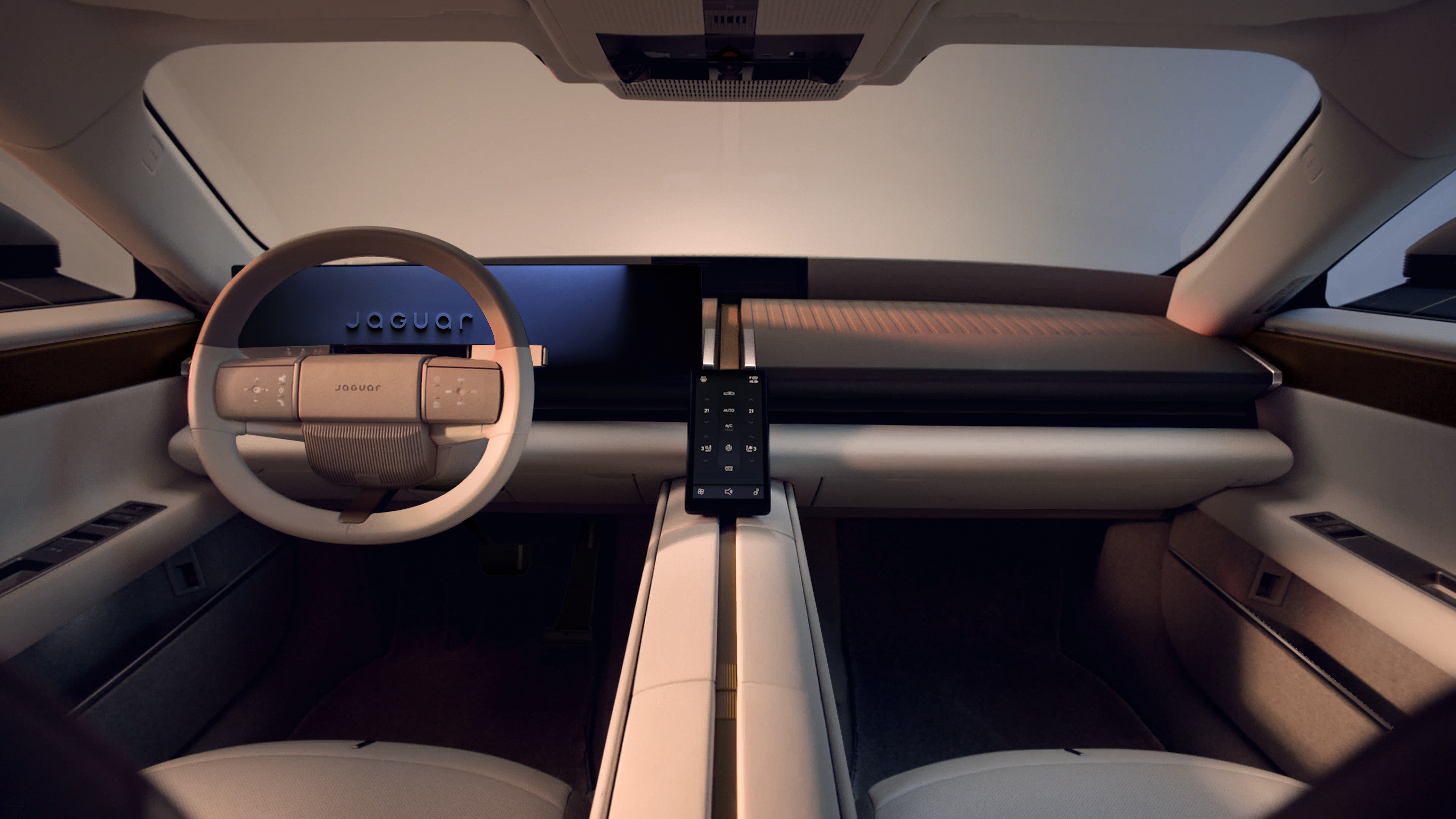
Jaguar has given the world its first official look inside the Type 01, revealing a four-seat cabin that carries many of the ideas first seen on the Type 00 concept into the forthcoming production GT.
Until now, almost everything we have seen of the Type 01 has been disguised. Prototypes have covered thousands of development miles beneath increasingly familiar camouflage, but Jaguar has now revealed a little more by showing the interior completely undisguised, giving us perhaps our clearest indication yet of how its new design philosophy will translate from the concept car to production reality.
The answer is that rather more of the Type 00 has survived than some might have expected.

At the centre of the cabin – quite literally – is the dramatic spine first previewed by the concept. It runs longitudinally through the entire interior, separating the four occupants and creating four clearly defined individual spaces rather than the more conventional arrangement of front and rear benches divided by a centre console. Jaguar describes this as bringing its “concept car vision” into production.
It also provides an interesting connection with the exterior proportions of the Type 01. Much has already been made of the production car’s extraordinarily long bonnet and cab-rearward stance, and Jaguar’s designers have deliberately continued that longitudinal emphasis inside rather than following the predominantly horizontal architecture that has become commonplace in modern electric cars.
Jaguar says the seating position has been set low, with the cabin wrapping closely around the driver to create the feeling expected of a sporting grand tourer, with the driver occupying a defined cockpit area.
Whatever else the new Jaguar becomes, it still has to feel like a Jaguar from behind the wheel, and the low driving position of Type 01 is far removed from the high-set seating and commanding viewpoint that has come to dominate the premium SUV and EV market.
Where are all the buttons?
Rather than covering the cabin with displays or buttons, Jaguar has attempted to integrate the technology into the architecture and keep much of it hidden until required. There is a substantial digital display ahead of the driver, while a much smaller portrait-format touchscreen rises from the central spine to provide access to functions including climate and infotainment controls. Concealed storage and other functions are similarly intended to reveal themselves only when needed.
It is an approach Jaguar describes as technology “on demand”, and it marks a deliberate attempt to move away from the increasingly familiar wall-of-screens treatment adopted by many contemporary luxury cars with the ability to select a driving mode that folds away all the screens and allows a heads-up display to show just the essentials while you get on with the pleasure of driving, free of digital distractions.
One particularly unusual solution is the rear-view display. The Type 01 dispenses with a conventional interior mirror and instead uses Jaguar’s digital ClearSight system. Rather than positioning its screen where a mirror would traditionally sit, it is mounted centrally at the foot of the windscreen, broadly level with the exterior door mirrors. The idea is to reduce the amount the driver’s eyes must shift their line of focus when moving between different rearward views. As there is no conventional rear window, the camera system is fundamental to rearward visibility.

Look and feel
There is an emphasis on unusual materials and the absence of conventional luxury-car decoration. Jaguar cites travertine stone and artisan textiles as influences on the Type 01’s tonal palette, while a brass-inspired finish extends along the central spine and across the upper sections of the doors.
Small Jaguar leapers are incorporated into these pieces – a comparatively subtle use of one of the marque’s most recognisable symbols within an otherwise deliberately minimalist cabin.
Jaguar’s so-called ‘strikethrough’ graphics extend across the dashboard and visually correspond with elements on the bonnet beyond the windscreen. Viewed from above, the intention becomes clear: rather than treating the dashboard as the point at which the exterior design stops and the interior begins, the lines appear to continue through the car.
Thomas Holden, Jaguar Chief Interior Designer, explained that this longitudinal architecture was a deliberate rejection of the industry’s usual horizontal approach.
“In contrast to the horizontal interior design norm, we emphasise its dramatic longitudinal nature through the central spine – an architectural statement that creates four individual spaces.”
Holden added that the combination of authentic materials, technology on demand and flowing surfaces is intended to create the “drama and theatre” Jaguar believes should distinguish the modern luxury interior.

A very different kind of Jaguar
For existing Jaguar owners, there is obviously little here that immediately recalls an XJ, XK or F-TYPE cabin, and, if we are honest, it’s all quite “extreme Scandinavian minimalism” at first glance. Traditional timber, analogue instruments and rows of physical switchgear have gone, but that should hardly come as a surprise. Jaguar has repeatedly made clear that Type 01 is not intended to be an incremental replacement for one of its previous models.
Instead, this is the first production Jaguar to be designed around the company’s new dedicated Jaguar Electric Architecture (JEA), and the interior demonstrates just how extensively that clean-sheet platform is being exploited.
The important question for enthusiasts will therefore be whether some of the less tangible qualities of Jaguar interiors have survived: the low seating position, the sense of sitting in rather than on the car, the relationship between driver and controls and, above all, that feeling of occasion that has characterised the best Jaguars.
Jaguar Managing Director Rawdon Glover says that is precisely the intention.
“With Type 01, we wanted every journey to be an occasion, from how it drives to how it looks and how it makes you feel.”
He describes the combination of a GT driving position, deliberately restrained technology and dramatic styling as creating “an interior like no other”.
Next stop: New York
There isn’t much longer to wait for the remaining pieces of the puzzle.
A Type 01 prototype is making its North American debut during Monterey Car Week, wearing a distinctive new camouflage treatment, culminating in an appearance at the Pebble Beach Concours d’Elegance on 16 August.
The complete production car will then finally be revealed in New York on 6 October 2026.