


The NEC Classic Motor Show has enjoyed a busy first day with the press, trade and public alike gathering to enjoy the exciting displays and exhibits at this enormous event. The Jaguar Enthusiasts’ Club enjoyed a prime position in the heart of Hall 1, with our complimentary coffee bar and lounge providing a tranquil space for the Jaguar community to gather, share their highlights from the show, and arrange to meet friends old and new.
The cars represent many of the stories we have been telling throughout the year. There are two examples of the XJ-S that show the contrast between the TWR-built Group A racing car that won the 1984 European Touring car championship and its very early production counterpart: a rare pre-HE XJ-S Coupé with a glorious V12 engine and factory-fitted manual gearbox. A perfect pairing and tribute to 50 years of the XJ-S.
We have the car that started the Jaguar name, the SS Jaguar 2.5 saloon, which has been kindly loaned to us for the show by the Jaguar Daimler Heritage Trust, marking that pivotal moment 90 years ago when Sir William Lyons announced the Jaguar brand to the industry at The Mayfair Hotel, London, in September of 1935.
Adjacent to the SS Jaguar, we have a 2024 FTYPE ZP Special Edition. So, have the very first Jaguar and the very last internal combustion-engined Jaguar sports car alongside each other—marking the transition of two eras.
Finally, we have another anniversary car in our racing Mk 1, which was victorious in the 2025 St Mary’s Trophy second round at Goodwood Revival, alongside a car that looks forward to the XK8 anniversary next year, when the model celebrates 30 years since launch.
If you are planning to visit the show over the weekend, we look forward to seeing you. If you’d like to read more about the cars on our stand, then see the profiles below for the full story!
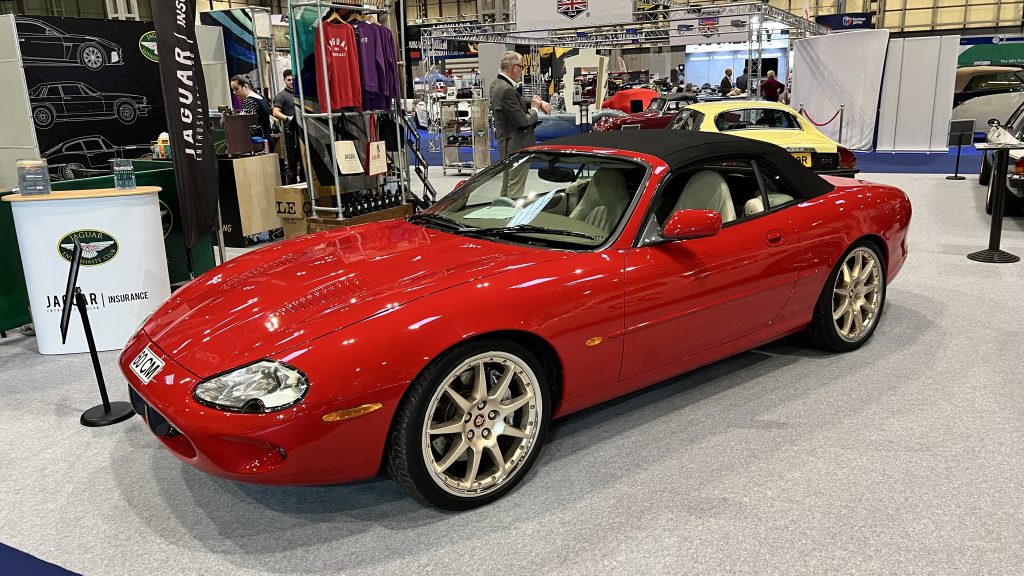
1999 Jaguar XKR Convertible (X100)
Celebrating 30 Years of the XK8 legacy–1996–2026
Vehicle Overview
Owned from new, this 1999 XKR convertible was ordered new from Stratstone Jaguar Cardi and registered in March of that year. After running the car for a year, Racing Green Cars, a Jaguar performance specialist at the time, was chosen to supply and fit a number of enhancements, including the extremely rare Racelogic F1 button-control gearbox conversion. This early version of today’s ‘paddle shift’ gives the driver an enhanced driving experience when driving spiritedly! The only body enhancement is the body-coloured tonneau cover supplied by Club supporter Adamesh.
Technical Specifications
- Engine: 4.0-litre Supercharged AJ-V8
- Power Output: 370+ bhp
- Transmission: 5-speed automatic with Racing Green / Arden Racelogic F1 button-control
- gearbox conversion
- Suspension: Racing Green / Arden lowered sports kit
- Exhaust: Racing Green / Arden stainless system
- Brakes: Upgraded braking kit and calipers
- Wheels/Tyres: 20-inch Montreal BBS split rims in Oyster finish (Includes the very first prototype
- wheel, obtained through Stratstone Jaguar Cardi)
- Steering: Racing Green / Arden switchable steering weighting control
- Colour: Phoenix Red
- Body Enhancements: Paramount solid body-coloured tonneau cover
Design & Heritage
As the 30th anniversary of the XK8 approaches in 2026, this one-owner XKR celebrates the increasing popularity of this modern classic Jaguar.
Introduced in 1996, the Jaguar XK8 marked a turning point for the brand — the first all-new grand tourer in over two decades and the debut of the modern X100 platform. Replacing the long-lived XJS, it showcased Jaguar’s return to elegant design and refined performance, powered by the new 4.0-litre
AJ-V8 engine that brought the marque into a modern era. Styled by Geo Lawson, the XK8 echoed classic E-Type proportions while embracing contemporary aerodynamics and luxury, defining Jaguar’s
“Grace, Space, Pace” philosophy for a new generation. Its success paved the way for the supercharged XKR and set the design language for Jaguars well into the 2000s — making 2026, its 30th anniversary, a milestone in Jaguar’s grand touring legacy.
1984 TWR Jaguar XJS – European Touring Car Champion
Celebrating 50 years of the XJ-S
Provided for display by the Jaguar Daimler Heritage Trust

Vehicle Overview
This 1984 TWR Jaguar XJ-S is one of the most successful racing cars ever produced by Jaguar, built and campaigned by Tom Walkinshaw Racing (TWR).
It dominated the 1984 European Touring Car Championship (ETCC), securing the Drivers’ and Manufacturers’ titles and marking Jaguar’s first major international racing success since the D-Type era.
Technical Specifications
- Engine: 5.3-litre V12, naturally aspirated
- Power Output: approx. 450 bhp
- Transmission: 5-speed manual
- Chassis: Steel monocoque with TWR roll cage and reinforced suspension mounts
- Suspension: Independent front and rear, TWR competition setup
- Brakes: Ventilated discs with racing calipers
- Wheels/Tyres: 16-inch BBS racing alloys with Dunlop competition tyres
- Weight: Approx. 1,400 kg (race trim)
- Top Speed: Over 170 mph (circuit dependent)
Racing Record
- 1984 European Touring Car Championship – Champions
- Drivers: Tom Walkinshaw / Win Percy / Hans Heyer
- Wins: 7 of 10 rounds, including Monza, Zolder, Brno, and Donington
- Constructors’ Title: Jaguar
- The XJS proved a match for BMW and Volvo rivals, thanks to its V12 torque, durability, and TWR’s engineering excellence.
Design & Heritage
The 1984 season marked Jaguar’s return to international motorsport prominence, setting the stage for the XJR sports-prototype programme that followed in Group C racing — leading to Jaguar’s Le Mans victories in 1988 and 1990.
This car also represents the renaissance of Jaguar in 1984, when sales of the XJ-S, which had stalled, were rejuvenated and Jaguar went independent from British Leyland under boss Sir John Egan, forging a new destiny for the brand.
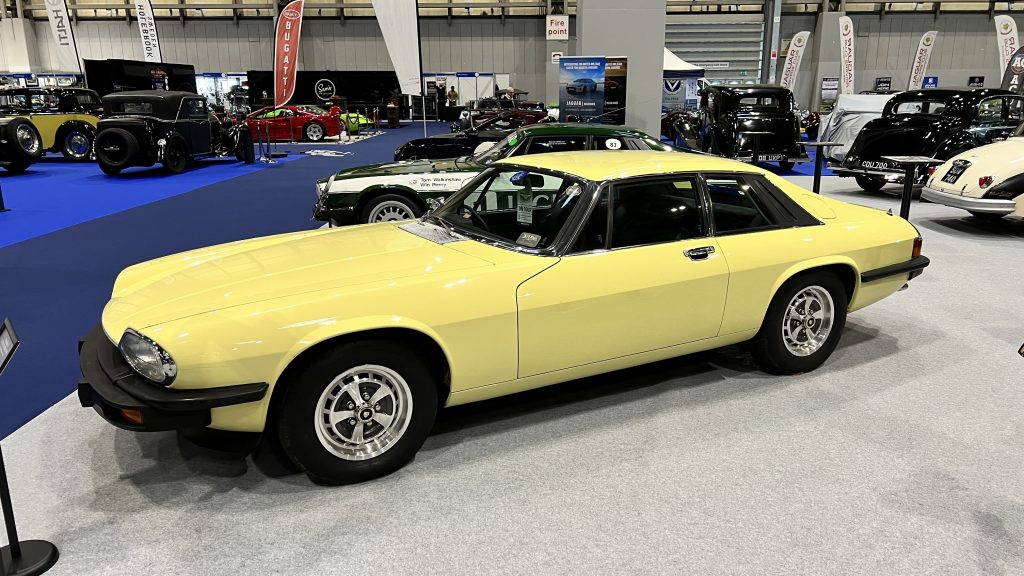
1976 Jaguar XJ-S 5.3-litre V12 Manual (Pre-HE)
Celebrating 50 years of the XJ-S
Vehicle Overview
This early pre-HE Jaguar XJ-S represents the model in its original 1970s specification, prior to the High-Efficiency (HE) revisions introduced in 1981.
Built in 1976, this example is one of the very few factory manual-transmission V12 cars produced and remains in outstanding original condition, having covered just over 12,000 miles from new. Carefully maintained by its first owner and subsequently preserved by enthusiasts, it retains its original trim, paint, and factory components.
Technical Specifications
- Engine: 5,343 cc V12 with Lucas Opus electronic ignition and Bosch/Lucas fuel injection
- Power Output: approx. 285 bhp
- Transmission: 4-speed manual (rare factory option)
- Chassis: Shortened and strengthened XJ saloon platform with reinforced steel (22-gauge panels)
- Suspension: Independent front and rear with twin anti-roll bars
- Brakes: Power-assisted discs all round
- Wheels/Tyres: 15-inch GKN “Kent” alloys with Dunlop SP Super Sport 205/70 VR15 tyres
- Performance: 0–60 mph in 6.9 seconds, top speed around 150 mph
- Weight: Approx. 1,700 kg
Design & Heritage
Launched in 1975 as the successor to the E-Type, the XJ-S was designed by Malcolm Sayer with a focus on aerodynamics and high-speed stability. Its distinctive “flying buttress” rear design was integral to its drag-reduction and cross-wind performance.
The early models featured large rubber impact bumpers to meet US regulations and a new chin spoiler and undertray developed during high-speed testing to improve front-end lift and cooling. The Lucas/Bosch fuel injection improved drivability and efficiency over the carburetted V12, while the stiffened monocoque provided exceptional refinement for a GT of its era.
Inside, the XJ-S featured leather upholstery, climate control, and a unique instrument layout with four central gauges and 18 warning lights — all part of Jaguar’s move toward a more modern, driver-focused cockpit. Wood veneer was omitted until the HE facelift of 1981.
MEET THE FIRST JAGUAR
1937 SS Jaguar 2½ Litre Saloon (CDU 700)
90 years since the name Jaguar first appeared!
Provided for display by the Jaguar Daimler Heritage Trust

Vehicle Overview
This 1937 SS Jaguar 2½ Litre Saloon was used by Mrs Greta Lyons, wife of Jaguar founder William Lyons, for her personal transport until 1946. Known as the “Lady Lyons Car”, it was retained by Jaguar Cars and remains an important part of the company’s early history. The non-standard radiator badge was a special feature, fitted at Mrs Lyons’ request.
Technical Specifications
- Engine: 2,663 cc OHV inline-six, developed with Harry Weslake
- Power Output: 102 bhp @ 4,600 rpm
- Transmission: 4-speed manual
- Chassis: Steel ladder frame with semi-elliptic leaf-spring suspension
- Bodywork: Coach-built wooden frame (early construction, before 1938)
- Brakes: Hydraulic drums front and rear
- Performance: Top speed 86 mph | Fuel economy ≈ 21 mpg
- Production: 6,777 cars built (1935–1949), of which 3,444 were coach-built
Design & Heritage
Launched at the Mayfair Hotel, London, in September 1935, the SS Jaguar 2½ Litre was the first model to carry the Jaguar name. At that meeting, Sir William Lyons asked the assembled journalists, dealers, and distinguished guests to guess the car’s value to make the point that it was affordable luxury at a surprising price. Its debut marked a step-change for the SS Cars Ltd. brand — introducing a new four-door saloon body and a modern overhead-valve six-cylinder engine that produced 45% more power than the earlier side-valve unit.
Jaguar’s move to all-steel body construction in 1938 made it the first of Britain’s specialist manufacturers to adopt the process, enabling higher production and setting the foundation for post-war Jaguar engineering.
The 2½ Litre saloon combined performance, refinement, and striking style at an exceptional price of £395, undercutting every rival in its class — a hallmark of William Lyons’ philosophy of offering “grace and value without compromise.”
Jaguar F-TYPE ZP Edition (2024)
The very last of the F-TYPEs, the last Jaguar sports car and a scarce special edition.
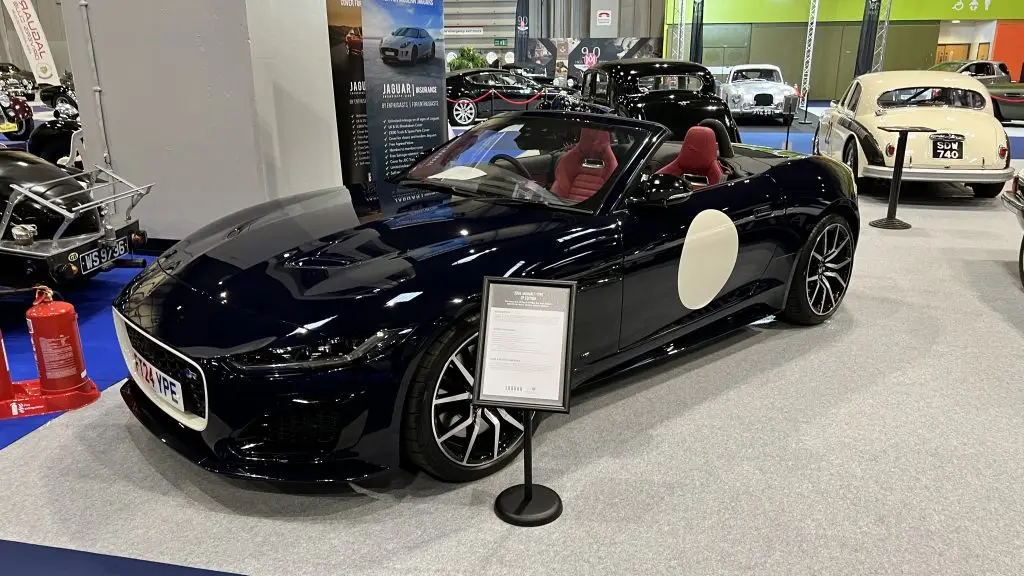
The F-TYPE ZP Edition is the last internal-combustion Jaguar sports car and a limited run of 150 cars worldwide, created by Jaguar’s SV Bespoke team to mark the end of F-TYPE production and Jaguar’s shift to its new all-electric era. It pays direct tribute to the 1961 “Project ZP” E-type race cars — the first E-types to win in competition — by recreating their colour and trim combinations. Offered as Coupé or Convertible, it represents the closing chapter of 75 years of Jaguar petrol sports cars.
Technical Specifications
- Engine: 5.0-litre supercharged V8
- Power Output: 575 PS (567 bhp), 700 Nm
- Drivetrain: All-wheel drive with Intelligent Driveline Dynamics
- Transmission: 8-speed Quickshift automatic
- Performance: 0–60 mph from 3.5 seconds; top speed 186 mph (limited)
- Body Styles: Coupé and Convertible
- Colours:
- Oulton Blue with Mars Red/Ebony interior
- Crystal Grey with Navy/Ebony interior
both with Porcelain White door roundels and white grille surround
- Build: Limited to 150 individually numbered cars with SV Bespoke commissioning plaque
Design & Historical Significance
In 1961, two lightly modified E-types ran under “Project ZP” and delivered Jaguar’s first competition wins for the new model. The F-TYPE ZP Edition lifts those liveries and applies them to Jaguar’s final V8 sports car, creating a direct line from E-type → F-TYPE at the very moment Jaguar retires ICE sports cars. That makes the ZP Edition the bookend car: final year of F-TYPE production (2024), final 575 PS V8, and the only series car to formally recognise the Project ZP racers.
1959 Jaguar Mk1 Saloon – “Project Utah”
St Mary’s Trophy (Part 2) winner, Goodwood Revival, 14 September 2025 – driven by James Dorlin

Vehicle Overview
This competition-prepared Jaguar Mk1 is the same model that returned Jaguar to the top step of the 2025 Goodwood Revival St Mary’s Trophy (Part 2) in the hands of James Dorlin, delivering a Jaguar win in the wet against a full field of 1950s touring cars. The car was supplied to us by West Riding Jaguar, who run and present the car in period-correct Goodwood specification. The Mk1 is especially significant in 2025 because it marks the 70th anniversary of Jaguar’s first compact unitary saloon, launched in 1955 as the 2.4 Litre.
Technical Specifications
- Engine: Jaguar XK straight-six, 3.4-litre competition tune
- Power: c. 210 bhp (Goodwood period spec)
- Transmission: 4-speed manual with competition ratios
- Chassis/Body: Unitary Mk1 bodyshell (Project “Utah”) with period racing safety equipment
- Suspension: Independent front with wishbones and anti-roll bar; live rear axle with locating links (Mk1 layout)
- Brakes: Disc/drum setup to period racing regulations
- Wheels/Tyres: Period-style lightweight racing wheels with Dunlop historic-pattern tyres
- Event: St Mary’s Trophy (Production saloons, 1950–59), Goodwood Revival 2025 – Race winner (Part 2)
Design & Historical Significance
Jaguar launched the 2.4 Litre saloon (later known as Mk1) 70 years ago exactly! Internally called Project “Utah”, the original 1955 Mk1 was Jaguar’s first compact, unitary-construction sports saloon, intended to bring XK-engined performance to a smaller, lighter, and more affordable four-door. It introduced the layout that would lead directly to the famous Mk2. The Mk1 was offered first as a 2.4 Litre and, from 1957, as the more powerful 3.4 Litre to satisfy export and racing demand. Its success in period touring-car racing made it a natural fit for Goodwood’s St Mary’s Trophy, where Mk1s still win 70 years on.


3 Responses
Well done J.E.C Brillaint email
Hi as iam a member of the Irish jaguar and Daimler club I love the nec car show I have to jags at the moment a jaguar s type 3.0 v6 petrol year 2002 and a jaguar xf 3.0 v6 petrol year 2008 engines in the to jags hasint let me down