

OPINION PIECE
Our editor reflects on what this week has meant for Jaguar, as Type 01 was revealed to insiders ahead of its public launch in New York, against the difficult backdrop of 4,000 job cuts across the wider JLR business.
There are weeks when being editor of Jaguar Enthusiast Magazine gives you a rather unusual perspective on the motor industry, and I don’t think there have been many quite like this one. Behind closed doors, alongside dealers, friends of the brand and members of the world’s media, I was fortunate enough to be among those invited to see the production Jaguar Type 01 without the camouflage which has hidden it from us for so long. I can’t yet tell you anything about what I saw – Jaguar quite understandably wants to keep its powder dry until the car’s public unveiling in New York on 6 October – but I can tell you that standing in front of the finished thing is a very different experience from looking at photographs of disguised prototypes, discussing the Type 00 concept or trying to piece together Jaguar’s future from all the speculation. There it was, a real car, the culmination of an extraordinary amount of work and, whether you agree with every decision Jaguar has made on the journey towards it or not, tangible evidence that the new era we have spent so long discussing is finally about to begin.
Yet it was impossible to experience that moment without being conscious of the other Jaguar Land Rover story unfolding at exactly the same time. JLR has announced that it intends to reduce its global workforce by around 4,000 people over the next two years, almost ten per cent of its approximately 43,000 employees, with the initial programme focused on voluntary redundancies among salaried and management staff and much of the impact expected to be felt here in Britain. Those numbers have inevitably generated headlines, but perhaps because I had just been standing in front of the product of so much human endeavour within the same company, I found myself thinking rather less about percentages, savings targets and corporate restructuring and rather more about the people those numbers actually represent.
What’s the significance?
Around 34,000 people work for JLR in the UK and, although the company has been owned by India’s Tata Motors since 2008, that fact can sometimes obscure just how profoundly British this business remains in terms of its people, skills and economic footprint. Across the Midlands in particular, generations of families have built their working lives around Jaguar and Land Rover, whether at Solihull, Gaydon, Whitley, Castle Bromwich, Wolverhampton or throughout the enormous network of companies supplying them. Behind every one of those 4,000 positions is a person with a career, a mortgage perhaps, a family and plans for the future, while beyond the factory gates are countless other livelihoods in suppliers, engineering consultancies, logistics businesses and local companies which depend, directly or indirectly, upon JLR continuing to design and build cars here.
We were given a particularly sobering reminder of just how important that is during last year’s cyberattack, when JLR production was brought to a halt, and the consequences travelled much further than the company’s own balance sheet. The disruption was significant enough to appear in Britain’s national economic figures, with the Office for National Statistics subsequently recording a 17.7 per cent fall in motor vehicle, trailer and semi-trailer manufacturing in the three months to October 2025, contributing around 0.10 percentage points to the movement in UK GDP. It is amazing to consider that a production interruption at one automotive manufacturer could be felt in the economic performance of an entire country, but it also shows why what happens to JLR matters far beyond those of us who happen to love Jaguars.
It also provides some important perspective when we talk about JLR being owned by an Indian parent company, because while Tata’s stewardship and investment have unquestionably shaped the modern business, the livelihoods being supported here are overwhelmingly real British ones. These are highly skilled jobs in engineering, manufacturing, research and development and the many disciplines which surround them, and once skills of that kind disappear from an economy they are extremely difficult to recreate. Britain has already learned that lesson in other industries and, whatever one’s view of individual cars, technologies or corporate strategies, I think we should be very careful about becoming indifferent to the health of one of the country’s largest and most internationally recognised manufacturing businesses.
Is it a Jaguar Land Rover problem?
So is this all a sign that JLR has got something wrong? Absolutely not; it is happening almost everywhere else in the established European motor industry. Volkswagen, Mercedes-Benz and BMW are all wrestling with enormous cost pressures and restructuring programmes, while Stellantis has been cutting jobs and reducing production across parts of its sprawling European manufacturing network. This is much bigger than JLR. The traditional European motor industry is attempting one of the greatest technological transformations in its history at precisely the moment when the geopolitical and economic environment in which it operates has become extraordinarily difficult.
Electrification sits right at the heart of that transformation and, whatever our individual views about electric cars, there is an awkward discussion to be had about the relationship between government policy and consumer demand. Manufacturers have been required to invest billions in battery technology, new vehicle architectures, software and factories in preparation for mandated changes to the cars they are permitted to sell, yet customers have not necessarily changed their buying habits at precisely the same pace. The direction of travel towards electrification seems clear enough, but the speed of that journey has increasingly become the difficult part, and manufacturers are having to make enormous investment decisions years in advance while attempting to predict what customers, governments and infrastructure will look like by the time those products finally reach showrooms.
JLR itself appears to have recognised that complexity, with its revised plans giving Range Rover, Defender and Discovery greater flexibility to offer combustion, hybrid and electric powertrains according to market demand, while Jaguar remains committed to becoming an electric-only luxury brand. I think that distinction is important because it demonstrates that this is no longer quite the simple all-or-nothing EV story it might once have appeared. JLR has to sell cars in many very different parts of the world, each travelling towards electrification at different speeds and for different reasons, and being able to respond to those markets may ultimately prove just as important as having the technology itself.
The coming of the Chinese
Then there is China, both as a market and increasingly as a competitor. It is remarkable how quickly names such as BYD, Omoda and Jaecoo have gone from virtually unknown in Britain to familiar sights on our roads, bringing cars loaded with technology and equipment at prices established European manufacturers find extremely difficult to match. At the same time, the German premium manufacturers have been losing ground in China itself, where increasingly sophisticated domestic brands are capturing customers who once automatically looked towards European marques. Add American tariffs, wars, volatile energy prices, disrupted supply chains and political uncertainty into that mixture and you begin to appreciate the almost bewildering number of variables facing somebody attempting to plan a global motor manufacturer’s next generation of products.
Exports therefore matter enormously, and perhaps we sometimes forget that when looking at the industry solely through the cars we see on British roads. More than three quarters of the cars manufactured in Britain are exported, because our domestic market alone simply cannot sustain the scale and cost of the industry we have built. For JLR, whose strategy is increasingly centred on relatively low-volume, high-value luxury vehicles, the ability to persuade wealthy customers in North America, Europe, the Middle East, China and elsewhere to choose a Range Rover, Defender or Jaguar is fundamental. These are the markets which generate the revenues needed to support British engineering and manufacturing, which is why tariffs and geopolitical events thousands of miles away can ultimately affect somebody’s livelihood in the Midlands.
Responding to the challenge
Against all of that, JLR’s response is not about retreating or battening down the hatches. In the style of true British grit, the company is trying to reduce its cost base substantially while continuing to commit enormous sums to new technology and products, and that distinction is worth making because cutting jobs and investing in the future are not mutually exclusive, however contradictory they may initially appear. Range Rover Electric is coming on stream, further Range Rover products are being developed and a smaller member of the Defender family is on its way, while JLR continues to invest heavily in electrification, software, manufacturing and the next generation of its brands. The intention appears to be a leaner company capable of making money from fewer, higher-value vehicles, with enough flexibility elsewhere in the range to respond to the way different markets actually develop.
Which brings me back to the car I was standing in front of this week, because Jaguar is perhaps the purest expression of that strategy and unquestionably its biggest gamble. Type 01 is not intended to replace the XE, XF or even the old XJ in the conventional sense, nor is Jaguar attempting to recover the volumes it enjoyed at various points in the past. The plan is to sell far fewer cars at substantially higher values, making Jaguar a smaller but much more profitable luxury business, and Type 01 is the first opportunity we will have to discover whether that theory survives contact with the customer.
Type 01 revealed
Having now seen the production car again without its disguise, the discussion has seriously moved forward, certainly for me. For the past couple of years we have argued about concepts, advertisements, logos, colours, positioning and strategy, often without the most important ingredient in the conversation: the actual car. Type 00 gave us a dramatic indication of the direction Jaguar wanted to travel, while the disguised Type 01 prototypes allowed us to infer proportions and packaging, but seeing the finished article brings everything back to where I have always felt the judgement ultimately has to be made. Jaguar is a car company, and eventually it has to be judged by the cars it creates.
NDAs keep me from spoiling the surprise Jaguar has planned for New York, and I wouldn’t want to, because part of the privilege of being invited behind those closed doors is respecting the confidence with which we were shown the car. What I can say is that the transition from Type 00 to the production car, Type 01, is now real rather than theoretical, and there is something quite sobering but also exciting about seeing the physical result of decisions which have generated so much discussion around the world. Very shortly, we will stop asking what the new Jaguar might look like and start discussing what it actually is, and from that point onwards the questions become much more meaningful: whether people desire it, whether customers will pay for it, whether it works as a luxury object as well as a motor car and, most importantly, whether it can establish a sustainable and profitable future for the Jaguar part of the JLR House of Brands.
The human connection
Being around the JLR HQ and factories recently, I have had the opportunity to talk to people who have spent their careers at the company. They have reminded me that there is far more continuity between the Jaguar of what many regard as its heyday and the Jaguar creating Type 01 than might be apparent from the outside.
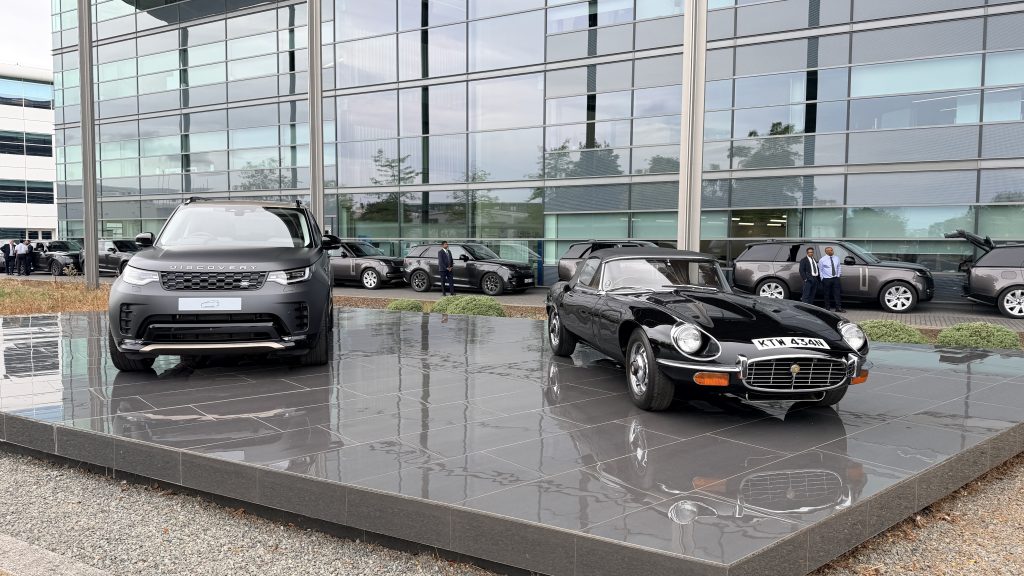
They made this point strongly to us at the Type 01 reveal. Many of the senior people responsible for creating, engineering, and launching Type 01 began their careers during those ‘heyday’ years, sometimes arriving as fresh graduates and working for people now revered in Jaguar folklore as heroes of the brand. Many of the younger team members are now second-, third-, or even fourth-generation members of the same family, all of whom have worked at Jaguar. What always strikes me is how enthusiastic and passionate the team at Jaguar are. They are true enthusiasts, and indeed, as a line-up of classic Jaguars parked outside the entrance on the day of the reveal, they all clamoured to take pictures and selfies for their socials – just as we would.
It’s easy to get caught up in mainstream media rhetoric and conclude that everything that came before has somehow been swept away. Yet cars are ultimately created by people, and there remains a thread running through generations of Jaguar engineers which no change of logo, advertising campaign or product strategy can entirely erase. Whether you personally will grow to like Type 01 is a future question. But what seems impossible to dispute is the passion of the people creating it. They are putting the same professional pride and enormous personal effort into making their new Jaguar succeed that previous generations put into the Jaguars we now cherish. Type 01 isn’t intended to appeal to everybody and nor is it expected to sell in mass-market numbers; the strategy depends instead upon creating a genuinely exceptional Jaguar for a much smaller group of customers prepared to pay considerably more for it.
Seen from that perspective, even the difficult announcement about 4,000 jobs becomes a little more nuanced. Nobody should underestimate what redundancy means for the individuals and families involved; that remains the most uncomfortable part of this week’s news, but we also shouldn’t automatically regard workforce reductions as evidence of a company in retreat. If JLR genuinely needs to rebalance its costs against the number and value of cars it expects to produce, doing as much of that as possible through voluntary redundancy is surely preferable to compulsory job losses. There will be people for whom the opportunity to leave voluntarily suits their own circumstances, just as there will undoubtedly be others for whom saying goodbye to JLR after many years will be enormously difficult.
So I don’t think this has been either a good week or a bad week for Jaguar. It has been something much more complicated than that. It has been a week that demonstrated both the enormous pressures facing one of Britain’s most important industrial companies and the extraordinary ambition still present within it, while reminding us that behind both sides of that story are people whose skills, careers, and livelihoods make it all possible.
The big reveal
On 6 October, when Type 01 is finally revealed publicly in New York, everyone will be able to see the car that I was fortunate enough to stand in front of this week, and the debate surrounding Jaguar will enter an entirely new phase. After all the controversy, speculation and camouflage, we will finally have something tangible upon which to judge this extraordinary reinvention.
For those whose jobs are affected by this week’s announcement, however, the consequences are already very tangible indeed, and amid all our excitement about what comes next for Jaguar, I think we owe it to them not to forget that, regardless of whether or not they are in the position where voluntary redundancy suits them.



13 Responses
I have been a Jaguar owner for over 30 years and have owned 5 cars including XJ6, XJS, XTYPE, XKR and currently for 8 years an X150. I am a little concerned with the current situation Jaguar is giving the impression it is downsizing and becoming a one model car manufacturer.
Hi Peter, they have clearly stated that there will be a 3-model line-up by the end of the decade.
A nicely constructed article which describes the current global context that Jaguar finds itself in well. The only comment I would add is the human one. I worked at Jaguar from 1983 to 2003 and helped engineer the vehicles of that era which are in the most well respected and loved to this day. Most of the senior team that have helped create, engineer and are launching Type 01 started their careers in that period and some of them worked for me starting as fresh graduates. I happened to bump into a couple of them recently and I was stuck by how they are enthused about Type 01 exactly as I was about XJ41, X300, XK8 and X Type at the points when I was working on them and they are giving all their efforts to make it a success. Whether you like the car or not, whether it is a success or not, what is clear to me is that it is a true Jaguar, conceived, created and delivered with all the passion of the prior generations. It is not meant to appeal to all, it is not planned to be a mass market car but it is planned to be a great Jaguar for those that are targetted as their future customers. I wish them every luck and hope it is a massive success. Meanwhile the shedding of 10% of the workforce by VR seems a very rational and necessary step in the circumstances of the global auto industry and if it can be delivered through VR it will be the most compassionate way for the company to re-balance it’s costs and income – again I wish them luck on their journey
What a great article giving the broader perspective of the challenges facing our motoring industry.
I have been wondering how much the adoption of AI has facilitated the pending loss of all those jobs. It would seem a logical decision for a manufacturer that has to cut costs whilst maintaining all the roles needed to keep functioning and it seems that these days AI ‘agents’ can easily fulfil those back office workers once they have been ‘trained’. If so, I feel so sad that the progression towards full automation is as often predicted one that replaces humans rather than enabling them to adapt to new roles and keep their jobs.
A good article, Wayne, and when I saw Type 01 on that same presentation, I was struck by the passion the people involved with it had for the new car. Shedding of jobs and recruitment are all part of the ebb and flow of our industry, and as you say, our European counterparts are facing similar issues, but Jaguar are not shrinking away, they are pressing on, quite rightly, with the development, build and launch of this exciting car of the future. Also, these redundancies are over a period of time, and VR will take up the vast majority of those. I remember at Jaguar during the very early ’80s the Company had to shed 3,500 from a workforce of just 11,000 but soon after that, as the Company’s fortunes improved, we started recruiting, and well beyond the original figure, so the ebb and flow effect was seen in action. I am positive they will weather the storm and come back fighting.
Long May Jaguar thrive and continue. My first JLR vehicle was a Daimler Sovereign 420 way back in the 1970s. Since then I have had XJ6 x type and XF. Currently an XFS. All splendid and all greatly appreciated and enjoyed. I wish JLR every possible success with the latest creation. Warmest regards. Simon
A very good article Wayne!
I just hope that the Type 01 has been thoroughly tested and is reliable!!
I heard numerous stories of problems with the iPace as if it was a prototype!! I had plenty of problems with my own E-Pace, most of them software.
If the new cars are not reliable then Jaguar is doomed!
As always Wayne, a well considered and balanced article. Unfortunate clash of timings across downsizing, Type 01, Goverment support, Range Rover GT etc.
It will be interesting to see if the 3 model line up makes it and whether folk can wait to the end of the decade. My present XF (my 3rd, that themselves followed 3 X-Types that brought me into the Jaguar and JEC community) might or might not but not if it fails like the 2 nd one recently did ….,
As the Editor of Rovers Magazine here in the US, I include a column in every issue on JLR news to connect our readers with the real-world issues confronting an influential yet small [by automotive standards] corporation. I have had the pleasure of meeting and interviewing many Land Rover executives over the years, and their corporate links mirror the positive impact Land Rover has made in the many communities in the Midlands and beyond. When I’ve met them in person, the first thing we both have done is to share photos of our heritage and new Land Rover and Range Rover models.
I attended Monterey Car Week in California last month and met up with two engineers from Jaguar who walked me through some of the unique features of the Type 01; the camouflage remained intact but I gained a real appreciation for the talent and innovative engineering of those engineering executives. At the Pebble Breach Concours display, Jaguar attracted a big crowd of automotive enthusiasts by also including Jaguars with tremendous provenance – from a D-type through an XJS.
In my column in this month’s issue, I remind all Land Rover enthusiasts that the success of Jaguar matters because, after all, we share the same company with the same corporate parent.
Oh dear!
If you snapped me in half like a stick of Brighton rock, it would read Jaguar in large red letters. The breed I fell in love with as an eight-year-old, first glimpsing my first ever E-Type sitting there ready to pounce in our neighbour’s drive.
Since those far-off days, I’ve owned quite a few, and today I still drive an XF during the cooler months and my XK8 for the warmer days. Two cars out of our four.
Grace, Space, Pace…
That was Lyons’ immortal mandate, but somewhere along the line, the stewards of JLR lost the plot.
Before Jaguar decides to reboot itself as a hyper-exclusive £100,000+ EV boutique aiming at Bentley and Rolls-Royce, they need a stark reality check. You cannot build a fortress on sand. Look at any recent J.D. Power or What Car? reliability survey, and JLR products consistently sit at or near the very bottom of the dependability tables, weighed down by endless electrical gremlins and software failures. What makes them think ultra-luxury buyers, who expect absolute perfection, will tolerate the sort of reliability issues that have plagued Land Rover and Jaguar for years?
The blueprint for luxury survival isn’t abandoning your core market; it’s expanding it. Look at the German triumvirate—BMW, Mercedes, and Audi. They built rock-solid global volume by branching down into premium compacts, hot hatches, and lucrative urban runabouts to capture younger, loyal buyers while keeping their flagship models aspirational. Even Mini proved how profitable high-margin, smaller cars could be when backed by distinct styling and heritage.
Instead of building a accessible, highly reliable “Golf-class” Jaguar or a sharp, premium urban compact to widen the net, JLR management has chosen to abandon the loyal, life-long enthusiasts who actually bought XFs, XJs, and XKs.
Challenging Goodwood and Crewe with zero historical evidence that current JLR build quality can support that level of expectation isn’t brave strategy—it’s commercial suicide. I fear Sir William Lyons must be turning in his grave.
My greatest fear is that in the not too distant future JLR will be a badge owned by the Chinese churning out cars built back in China. I just hope I am proved wrong…
A sober(ing) look at the whole situation. Welcome in the mess of social media comment. The point for most of us though is that Jaguar has moved away from most of the current adherents and created a model(s) beyond our reach. Strategically understandable but a major risk nonetheless. Will it be successful in an already crowded market? I have serious doubts.
The comparison of job cuts at JLR with companies such as Volkswagen is a false one.
JLR insist they are not cutting production line jobs whereas VW are planning to close 4 entire factories. The latter because of the competitive pressure from Chinese manufacturers, which has hit VW sales hard both in China and Europe. The only thing that has reduced Jaguar sales to zero has been JLR management, starting from the announcement by Bollore in February, 2021.
And no details of what these people facing redundancy at JLR do/did. Are they involved in
(i) design and engineering of Jaguar cars,
(ii) design and engineering of the production line,
(iii) training of production line workers,
(iv) establishing a supply chain of components.
All of the above? None of the above? More detail is needed.
An interesting piece is in The Sunday Times today called ‘the JLR fightback’. It leads on the business section, and takes up half a page inside. Type 01 is dismissed in one very short paragraph. Instead, the ‘fightback’, i.e. the part of the story judged to be important, is about a pickup version of the Defender to be built in the US. Presumably that’s where JLR management see where the money is, in the design of a giant 4-door wheelbarrow.
Looks like I was right on at least one of the roles – see recent posts on LinkedIn.