
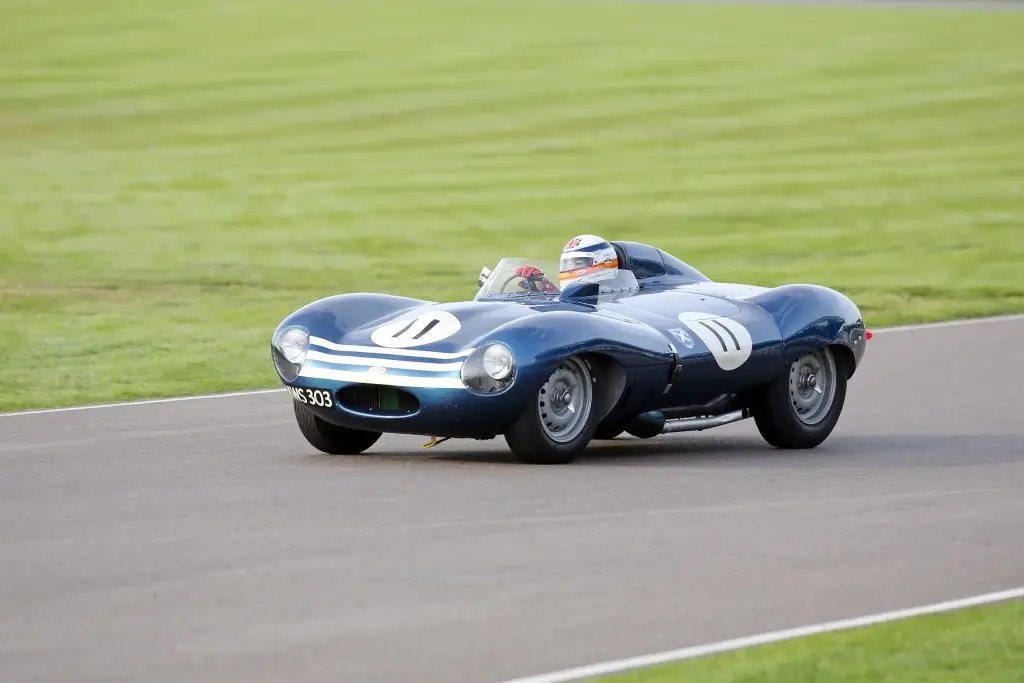
Celebrating the 70th anniversary of Ecurie Ecosse’s historic 1956 victory
When the chequered flag fell at Le Mans on the afternoon of 29 July 1956, Ecurie Ecosse secured its place in motorsport history. Seventy years ago this year, an independent Scottish racing team travelled to Le Mans with first-class preparation, a close relationship with Jaguar, and an unwavering belief that it could take on the world’s greatest manufacturers. Twenty-four gruelling hours later, that belief had been rewarded with one of the finest victories ever achieved by a British racing team.
At the wheel of the distinctive Flag Blue Jaguar D-Type numbered ’18’, Ninian Sanderson and Ron Flockhart completed 300 laps of the Circuit de la Sarthe to claim overall victory in the world’s toughest endurance race. As Sanderson crossed the finish line, he became the first Scot ever to win the 24 Hours of Le Mans, while Flockhart claimed the first of what would become two consecutive victories at the great French classic.
By 1956, Jaguar had already established itself as one of endurance racing’s dominant forces. The revolutionary D-Type, with its Malcolm Sayer-designed aerodynamic bodywork, monocoque construction and pioneering disc brakes, had transformed sports car racing. Following the 1955 season, during which Le Mans was overshadowed by the greatest tragedy in the event’s history, Jaguar concluded its official works programme. Yet the Coventry manufacturer continued to support leading private entrants, supplying customer D-Types built to works standards and maintaining close technical relationships with teams capable of carrying the marque’s reputation forward.
Rather than signalling the end of the D-Type’s success, the withdrawal of the factory team opened the door for the very best private entrants. None was better prepared than Ecurie Ecosse.
Founded by Edinburgh garage owner David Murray, the team had rapidly earned a reputation for professionalism that matched, and often exceeded, many manufacturer operations. Everything reflected Murray’s uncompromising standards. The transporters, workshops, immaculate blue overalls, spotless pit equipment and beautifully prepared Jaguars projected an image every bit as polished as the works teams. Behind that presentation stood a relatively small group of mechanics and engineers whose dedication, organisation and attention to detail consistently allowed them to compete with rivals possessing far greater resources.
Le Mans has never been won by outright speed alone. For twenty-four hours, every component, every pit stop and every decision is tested to destruction. Drivers must balance pace with mechanical sympathy, engineers must anticipate problems before they arise, and teams must execute every stop with flawless precision.
In 1956, Ecurie Ecosse mastered that balancing act better than anyone. Sanderson and Flockhart drove with the discipline endurance racing demands, preserving their D-Type while remaining firmly in contention throughout the race. As rivals from Ferrari, Aston Martin and other leading manufacturers succumbed to mechanical failures, accidents and setbacks through the long French night, the Scottish team’s meticulous preparation, calm execution and unwavering consistency steadily carried the blue Jaguar towards the front.
Behind the scenes, David Murray’s team never lost its composure. Every pit stop, every strategic decision and every mechanical check reflected the professionalism that had become the hallmark of Ecurie Ecosse. It was not simply a victory built on a remarkable racing car, but on a remarkable team.
Between 1951 and 1957, Jaguar claimed five outright victories at Le Mans, an extraordinary period of dominance that transformed the company’s reputation around the world. The 1956 success proved that the brilliance of the D-Type extended well beyond the factory programme. In the hands of the right team, it remained virtually unbeatable.
Ecurie Ecosse would underline that fact by returning just twelve months later to win Le Mans again in 1957, becoming one of only a handful of private teams ever to secure back-to-back victories in the world’s greatest endurance race. Flockhart claimed his second successive win, cementing his place among Britain’s finest endurance racers, while the team’s reputation became firmly established as one of the greatest privateer operations the sport has ever known.
Today, the names Ninian Sanderson and Ron Flockhart rightly remain celebrated, but this anniversary also belongs to the man who built the team.
David Murray proved that exceptional leadership, uncompromising professionalism and unwavering standards could overcome disadvantages that appeared insurmountable. Around him stood a group of mechanics, engineers and support staff whose names rarely appeared in the headlines but whose contribution was every bit as important as those behind the wheel. Together, they demonstrated that meticulous preparation, teamwork and determination could overcome the might of the world’s largest manufacturers.
Le Mans has produced countless famous victories over more than a century of endurance racing, but few have captured the imagination quite like this one. An independent Scottish team, operating far from the resources of Europe’s great factory operations, defeated the very best through preparation, discipline and unwavering belief. Seventy years after that remarkable July afternoon, Ecurie Ecosse’s victory remains not only one of Jaguar’s greatest triumphs, but one of the finest underdog stories in the history of British motorsport.