
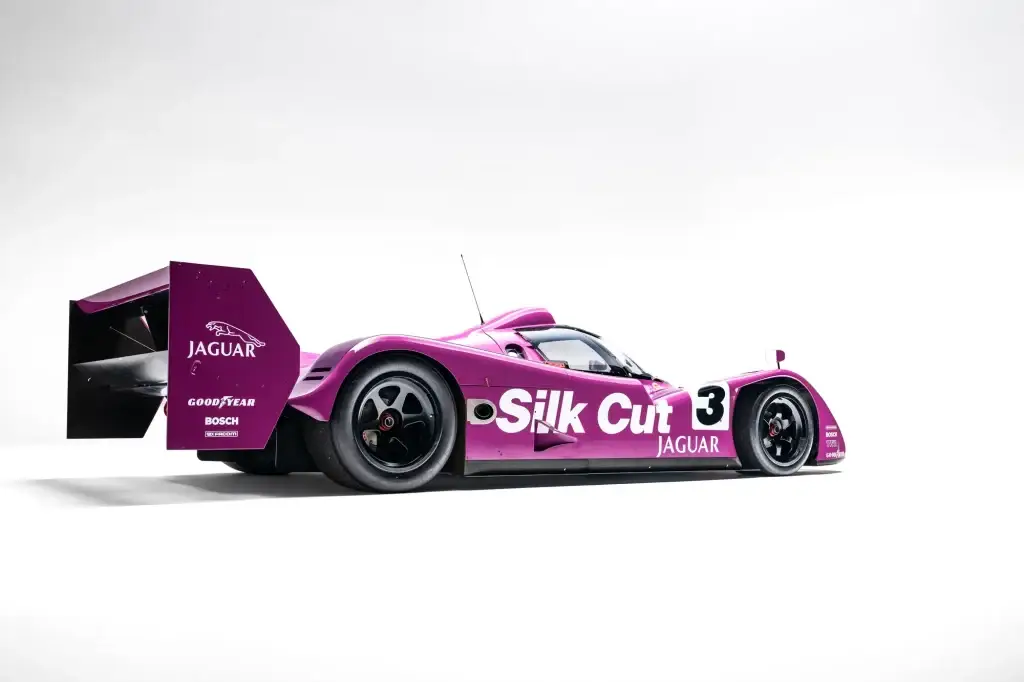
One of the most important racing Jaguars of the modern era has come to market. A 1991 Jaguar XJR-14 is now being offered for sale by Mouse Motors, giving collectors the rare opportunity to acquire a genuine Group C-era thoroughbred.
This is not simply a Group C car. It is the final evolution of Jaguar’s factory prototype programme — and a machine that delivered victory at the highest level.

The Final Evolution of Jaguar Group C
By 1991, the World Sportscar Championship had adopted new 3.5-litre regulations aligned with contemporary Formula One engine rules. Jaguar’s response was the XJR-14 — a clean-sheet design created under Tom Walkinshaw Racing.
The shift in philosophy was dramatic.
Gone was the big-capacity V12 that had powered Jaguar’s late-1980s endurance racers. In its place sat a 3.5-litre naturally aspirated V8 derived from the Ford HB Formula One engine, rebadged for Jaguar competition use, having previously been marked as exclusive to Benetton F1. The car was built around a carbon-fibre monocoque chassis and featured advanced aerodynamics, making it lighter, more compact and more agile than its predecessors.
In effect, the XJR-14 was a closed-cockpit Formula One car adapted for endurance competition.
TWR brought in Ross Brawn from Arrows F1 to design a new car unrelated to the outgoing V12s. Entry and exit were via the rear, with no conventional doors, underlining how far the car had moved from traditional endurance‑racing practice.
Only three chassis were constructed: 591, 691 and 791 — all finished in Silk Cut livery and run as works entries.

Chassis 791 – Built to Win
Chassis 791 was introduced mid-season during Jaguar’s 1991 title campaign and immediately proved competitive.
Most notably, 791 secured victory at the Nürburgring 1000km, driven by Derek Warwick and David Brabham. That win formed an important part of Jaguar’s successful push in the 1991 World Sportscar Championship.
The XJR-14 programme ultimately delivered the championship for Jaguar, marking the final time the marque would claim the world sportscar crown in this era.
Unlike earlier Jaguar prototypes, the XJR-14 was not entered at Le Mans in 1991. Instead, TWR ran the proven XJR-12 at La Sarthe, while the newer 3.5-litre car focused on championship rounds best suited to its sprint-oriented design.

IMSA Career and Later History
Following the wind-down of Jaguar’s factory World Championship effort, chassis 791 was exported to the United States to compete in IMSA GTP competition.
There, it demonstrated its pace once again, scoring a dominant victory at Road Atlanta. Its active race career came to an end after an accident at Lime Rock Park.
As with many top-level prototypes of the period, the car subsequently passed into private hands and has since been preserved as one of the most significant Jaguars of the Group C era.
Mouse Motors describes the car as an authentic works chassis with documented competition history, representing a rare opportunity to acquire a key piece of Jaguar’s factory racing programme.

Le Mans and a fascinating link to Porsche
The Jaguar XJR-14 eventually did reach Le Mans by being transformed into the winning TWR-Porsche WSC-95. Originally a 1991 World Sportscar Championship winner deemed too fragile for 24-hour races, its leftover chassis was modified by Tom Walkinshaw Racing (TWR) for Porsche, featuring an open cockpit and a flat-six engine to win Le Mans in 1996 and 1997.
Why the XJR-14 Matters
The XJR-14 represents a pivotal moment in Jaguar’s motorsport history:
- Jaguar’s final World Championship-winning prototype
- A radical transition from V12 endurance racers to 3.5-litre F1-derived technology
- One of only three factory-built chassis
- A Nürburgring 1000km winner
- Campaigned by leading drivers of the era
Technically advanced, historically significant and produced in extremely limited numbers, the XJR-14 stands as one of the most important competition Jaguars of the modern era.
Works Group C Jaguars seldom appear on the open market. A chassis with confirmed factory provenance, championship relevance and international competition history is rarer still.
Further details, pricing and viewing arrangements are available directly from Mouse Motors.